Suki Liebow is an award winning contemporary artist whose work explores themes of identity, emotion, and what it means to be human. While Suki’s abstract works often lean into exposing inequities to [still] marginalized demographics of humans, her overall work is motivated by her desire to live in a more joyful society where we all feel at home.
Creation Series

“Roots” 4rd in the Creation series
Making it’s Debut at the Municipal Gallery of Mykonos, Greece June 22nd, 2026
Acrylic, wire and resin enamel on canvas
37″ x 35″ x 3″
2026
“Roots” Detail Images


Roots, the fourth work in the “Creation” series, making its debut at the Municipal Gallery of Mykonos for Suki’s first solo exhibition, is a conceptual representation of the continents of Earth unified as a single blooming tree.
Highly textural, the artwork features over 350 individual, handmade wire and enamel flowers and roots. It is displayed in a grid of 24 canvases depicting a tree in a gradient of full blooms with a contrasting gradient background. The background gradually transitions from dark to light symbolizing both the daily cycle of day to night, and the seasonal, climatic changes of our planet. Below the main grid, a single “informing” canvas reveals a tiny human cocooned in the tree’s roots, dreaming reality into existence through a tiny cupule hat. This figure suggests that all of created reality is influenced by even the smallest imaginings.
The artwork incorporates eight distinct floral species. Seven species represent the continents—six varieties of blooming trees and one ground plant—while the addition of the Olive species represents global unity and peace as well as Suki’s connection to Greece. Antarctica, the only continent without blooming trees, is represented by the pearlwort flowers on the ground below the tree; one of only two native varieties of plants that bloom there.
Roots explores the duality of separation and profound connection. Though the world is broken into continents (visually represented by the fragmented image spanning the grid of canvases as well as the multiple varieties of flowers), the piece asserts that we are indisputably connected and invites the viewer to consider how individual imaginings contribute to our collective reality.

“Earth” 3rd in the Creation series
With a Youth Perspective by Daniel Levy, Age 17
Acrylic, wire and enamel on canvas
37″ x 51″ x 2″
2025
“Earth” Detail Images


Earth, third in Suki Liebow’s “Creation” series, is an exploration of a changing planet, a visual representation of a system failing, and an invitation to recognize our role in visualizing and implementing a new direction.
Whether the topic is climate change, government, social, or personal, systems and relationships are constantly changing. Earth is a reminder that while we may have a crisis on our hands, we also have agency and a responsibility to contribute our own vision, narrative, and action to create the kind of world we want to live in.
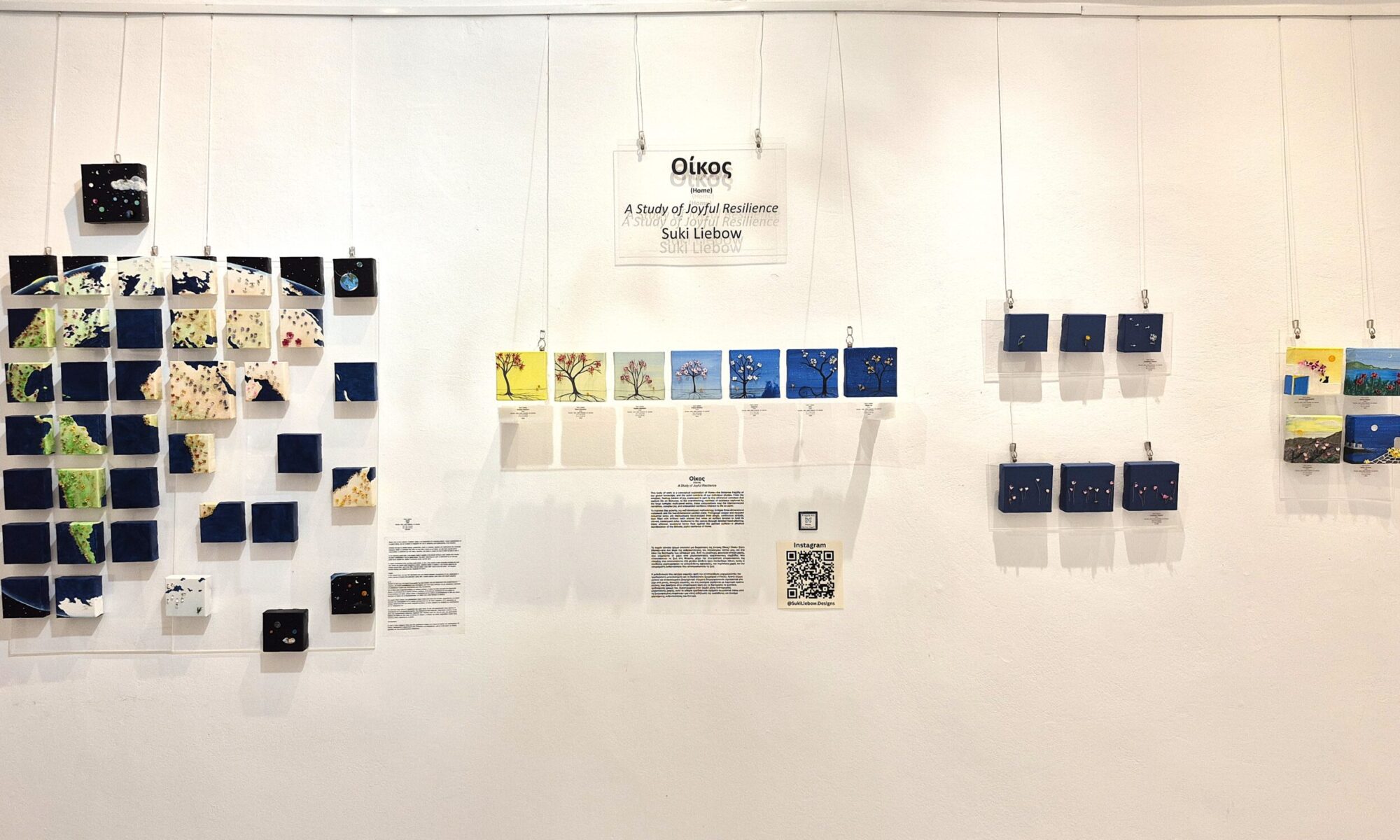
Description: In the informing panel (top), a tiny human waters a garden in the clouds causing rain that forms a solar system including the earth represented in the 38 panels below. The earth, beginning as a grid, is interrupted by an odd size panel which causes the “system” to become erratic and fall apart.
In space surrounding Earth are three small panels. In one, a tiny human is seen physically mending the earth with needle and thread while visualizing a whole, unbroken planet. In another, a tiny human observes the planets and changes happening around them, and in the third, a tiny girl reads a book titled “how to save the world,” her thoughts actively forming new planets as she visualizes the future.
In this artwork there are over 500 handmade wire and enamel elements representing 23 rare, endangered or extinct species of flowers and pollinators, along with 2 animal species; polar bears and empire penguins.


Earth – A Perspective by Daniel Levy, Age 17 (Click to Expand)
The effects of a warming planet have forced many species around the globe to adapt in unique ways. From butterflies to penguins and flowers, climate change has taken a deleterious toll on populations of numerous species. Scientists are actively examining and researching how and why certain species obtain specific adaptations and the effect climate change may have on specific populations.
There are three types of adaptations: structural, physiological, and behavioral. Due to hotter temperatures, bird pollinators may need to reduce their body size, a structural adaptation that allows them to dissipate more heat while potentially reducing their effectiveness at pollinating. Consequently, many flowers may change when they bloom to correlate with the change in pollination times, a physical adaptation. As a result, moths may need to shift their foraging times to coincide with earlier flower blooms, a behavioral adaptation. As global warming plays an increasingly prominent role as a selective force in evolution and speciation, it behooves us to elucidate how both species and us humans are adapting in response to environmental shifts.
Anthropogenic climate change has a huge impact on insect species, especially on butterflies and moths of the insect order Lepidoptera. Studying their evolutionary and ecological responses to climate change is crucial to gaining insight into the impact of global warming on genetic, morphological (what organisms look like), and physiological traits (the functions and processes of organisms). Many species of Lepidoptera are specialists that have a narrow ecological niche and need specific environmental conditions to thrive. Burdened with an accelerating temperature change, even flowers that were once abundant are changing their nectar traits, affecting pollinators negatively. Furthermore, Lepidoptera are ectothermic animals. In other words, they rely on the temperature of the surrounding environment to maintain a stable body temperature and perform their intended functions in the ecosystem. Thus, when their preferred habitat changes due to rising atmospheric temperatures, their range shifts and often leads to noticeable population decline. Notable effects on Lepidoptera due to climate change include reduced body size as well as completing more generations per year, which is a phenomenon known as multivoltinism. Furthermore, many butterfly species are expanding toward the poles to avoid warming temperatures.
Due to rising sea levels, many marine animals are negatively affected by environmental pollution, forcing them to adapt, albeit inadequately. A notable instance of adaptation can be seen in that of the polar bear (ursus maritimus). Their daily energy expenditure (DEE), or the total amount of energy in calories used in a full day, increased by a 5.2-fold range on land, and activity increased by a 19-fold range, according to one study using data from Manitoba, Canada. Since polar bears are increasingly making energetically demanding swims and foraging on land, most of them face a very high risk of starvation in spite of their high behavioral plasticity. They are also apex predators, species at the top of the food chain in their ecosystems, primarily hunting blubber-rich and energy dense ringed and bearded seals. Much of their energy resources are obtained between late spring and early summer, since the aforementioned seals tend to give birth to their pups during this short duration.
Another animal adapted to the polar climate, the emperor penguin, has also experienced significant population declines in Antarctica. Multiple years of poor breeding have negatively affected their populations, especially since they can only produce one egg per season with low juvenile survival rates. Now more than ever, we must protect species in the arctic, especially since the rate at which they adapt is not nearly sufficient to meet the pressing demand of a warming climate.
The onus falls on us to conserve and preserve the biodiversity of this unique blue planet. After all, nature is cyclical and full of patterns—from seasons to nutrient cycles to the symbiotic relationships that maintain a healthy environmental balance. Our greenhouse gas emissions have created a positive feedback loop, where warming the planet leads to a self-reinforcing cycle of higher temperatures, such as through increased water vapor feedback and wildfire feedback. It is our responsibility to lessen the impact of feedback loops while maintaining Earth’s natural cycles.

“Gardening” 2nd in the Creation series
Acrylic, wire and enamel on canvas and acrylic rounds
3.75′ x 3′ x 8″
2024
“Gardening” Detail Images


Gardening, the second work in the ‘Creation’ series, is a whimsical depiction of the creation of joy.
In a world often defined by grief and divisiveness, this work is an invitation to consider how the smallest actions contribute to the larger reality we all share. Joy, like suffering, can be created. The piece challenges the viewer to recognize their agency and responsibility in actively creating the world they want to live in.
The piece features a tiny human spraying a garden hose beyond the borders of the canvas, launching water into space and subsequently creating multiple “worlds” from this single, small action. Along the streams of water, a multitude of intricately handmade elements—flowers, birds, pollinators, and even the sun—emerge, illustrating the expansive impact of a modest act. Each water “droplet” contains a unique, delightful scene with its own handmade 3-dimensional element, tangibly drawing the concept into the reality of the viewer.

“My Love” 1st in the Creation series (Sold)
Acrylic, wire and enamel on canvas
5.5′ x 4.5′ x 2″
2023
“My Love” Detail Images


About This Work
My Love, first in the Creation Series, is made up of 50 6”x 6” panels informed by one panel to the right with a small girl blowing bubbles into the void. It could be interpreted that this tiny one is the beginning of everything; of life, perhaps.
Suki’s intention with this piece was to capture the sweetness of life in each bubble.
At times fragmented into separate panels but ultimately all part of the connected whole, each bubble captures a moment; of companionship, solitude, our beautiful planet, and the experiences that remind us that in the chaos, what matters is this.
Note: Each tiny wire element is designed and handmade with wire and enamel by the artist.
Mykonos Collection
2026

“Mykonos Seasons” (Listed left to right)
“Summer Bougainvillea”
Acrylic, wire and resin enamel on canvas
5″ x 5″ x 3″
2026
“Autumn Cyclamen”
Acrylic, wire and resin enamel on canvas
5″ x 5″ x 3″
2026
“Winter Jasmine”
Acrylic, wire and resin enamel on canvas
5″ x 5″ x 3″
2026
“Spring Poppies”
Acrylic, wire and resin enamel on canvas
5″ x 5″ x 3″
2026
Mykonos Collection
For Efimerides Gallery
2025

Acrylic, wire, enamel on canvas 2.4″x2.4″

Acrylic, wire, enamel on canvas 2.4″x2.4″

Acrylic, wire, enamel on canvas 2.4″x2.4″

Acrylic, wire, enamel on canvas 2.4″x2.4″

Acrylic, wire, enamel on canvas 2.4″x2.4″

Acrylic, wire, enamel on canvas 2.4″x2.4″

Acrylic, wire, enamel on canvas 2.4″x2.4″

Acrylic, wire, enamel on canvas 2.4″x2.4″
2024


Night Sky

Acrylic, wire, enamel on canvas 2″x2″

Acrylic, wire, enamel on canvas
4″x 4″

Acrylic, wire, enamel on canvas 2.4″x2.4″

Acrylic, wire, enamel on canvas
2.4″x2.4″

Acrylic, wire, enamel on canvas 2.4″x2.4″

Acrylic, wire, enamel on canvas 2.4″x2.4″
Joy

Acrylic, wire and enamel on canvas – 2.4″x2.4″

Acrylic, wire and enamel on canvas – 2.4″x2.4″

Acrylic, wire and enamel on canvas – 2.4″x2.4″

Acrylic, wire and enamel on canvas – 2.4″x2.4″

Acrylic, wire and enamel on canvas – 2.4″x2.4″

Acrylic, wire and enamel on canvas – 2.4″x2.4″
Cats

Acrylic, wire, enamel on canvas 4″x4″

Acrylic, wire, enamel on canvas 4″x4″

Acrylic, wire, enamel on canvas 4″x4″

Acrylic, wire, enamel on canvas 4″x4″

Acrylic, wire, enamel on canvas 4″x4″

Acrylic, wire, enamel on canvas 4″x4″

Acrylic, wire, enamel on canvas 4″x4″

Acrylic, wire, enamel on canvas 4″x4″

Acrylic, wire, enamel on canvas 4″x4″
Complex Minimalism

Acrylic, wire and enamel on canvas
12″x9″x1.5″

Acrylic, wire, enamel on canvas
8″x10″
“Bloom“ – A 24 hour Collaboration with Rahchayl Rain (aka “Mom”)
Graphite and mixed media on canvas
21″ x 48″ x 1.5″
2020
Bloom, a pivotal work in Suki Liebow’s career, is her first multi-panel creation that integrates three-dimensional elements into a two-dimensional plane.
The piece was created by Suki Liebow and her Mother during a 24-hour art marathon (artathon) in 2019/2020. During this project, Suki’s mother introduced her to the wire and enamel medium, resulting in a dramatic pivot in the direction of Suki’s work, and ultimately leading to ever-increasing layers of complexity and mastery of the craft.
Bloom captures 24 tiny joys in simple graphite sketches alongside a three-dimensional flower made of mixed media. The 24 canvases represent the 24 continuous hours of creation, while the intricate jewelry chain symbolizes the connectivity of each moment as a collective whole.
This work profoundly represents the beginning of a progressive theme of joy in Suki’s body of work.


